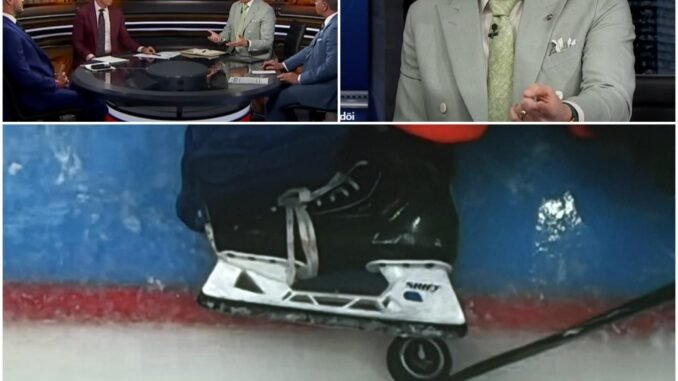
Elliotte Friedman didn’t come out with a crazy, attention-grabbing speech—he just expressed what a lot of people were already thinking, and that’s what made it so impactful.
When he asked how anyone could say for sure that the puck was a goal without a clear view or proper positioning of the officials, he didn’t just start a conversation—he revealed a flaw in how the NHL officials are trusted.
This was more than just a quick play. It was overtime during a playoff match—where reputations can change and seasons can end badly. Yet, the choice that affected Game 4 between the Edmonton Oilers and the Anaheim Ducks seems to be based more on guesses than actual proof.
Let’s be honest: where’s the proof?
Every replay showed a crowded area in front of the goal—sticks swinging, skates moving, players blocking every important view. The puck? It was nowhere to be seen when it counted the most. According to NHL rules, for a goal to count, the puck must completely cross the line. Not “probably. ” Not “it seemed like it.” Completely. Clearly. Without a doubt.
So how did the officials feel so sure when the videos showed so much doubt?
That’s the real issue. It’s not just that a call was made—it’s that they were sure in a situation that needed more caution. The fact that there wasn’t an official in the right spot in front of the net should have raised huge concerns. Instead, it was overlooked in a decision that could have changed the whole series.
Even the experts can’t agree. Discussion panels go back and forth for hours. Fans fight about it on every social media site. And that’s the problem—when the analysts can’t come to a conclusion, how can the call on the ice be so definite?
This isn’t just annoyance—it’s a matter of trust. In playoff hockey, even the smallest mistake can be a big deal. And when a game is decided without clear proof, it doesn’t just hurt…
…it stays with you.
Leave a Reply