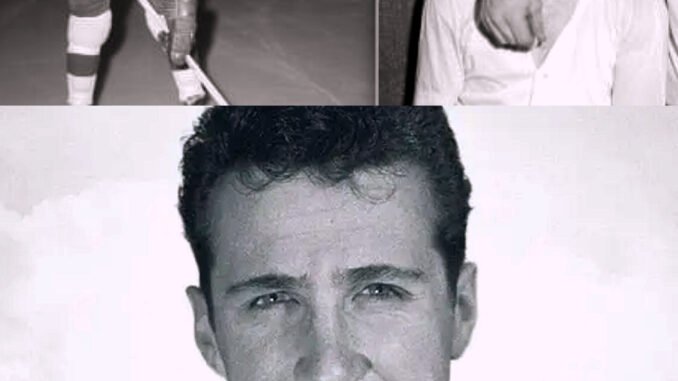
A legacy spanning two professional leagues is left behind by the former NHLer, who Gordie Howe trained.
Former NHL forward Eddie Joyal, who was one of the early expansion era veterans in the sport, passed away at the age of 86 on Monday, according to the hockey world. In response to the NHL Alumni Association’s announcement, admirers and groups paid respect to the Edmonton native for his perseverance over a career that spanned two professional leagues and several teams.
Joyal began his career in the junior leagues of Alberta, playing for both the Calgary Stampeders and the Edmonton Oil Kings. He then went on to play for the Edmonton Flyers of the professional Western Hockey League, where he helped them win the league championship in 1961–1962. What would be a long and well-traveled professional career was established by that championship run.
Gordie Howe mentoring a Red Wings rookie
When Joyal arrived in Detroit for the 1962-63 season, he found himself amidst hockey legends. The young Albertan was taken under the wing of the legendary Gordie Howe, who was still performing at an elite level. Joyal made a rapid impact, scoring 10 points in his first 14 games in the NHL. He rapidly established his suitability for the major platform.
Some really unforgettable moments came from his period in Detroit. With Howe recording the assist, Joyal scored a goal in Game 4 of the 1963 Stanley Cup Final against Toronto. He scored the game winner against legendary goaltender Johnny Bower the following spring to give Detroit a 3-2 series lead in the 1964 Cup Final, possibly the greatest goal of his career. The championship was won by Toronto, who made a comeback to win Games 6 and 7, much to the dismay of Joyal and the Red Wings.
On January 18, 1964, Joyal also made a modest but significant contribution to hockey history when he scored the insurance marker during Terry Sawchuk’s 2-0 shutout of Montreal. With that clean sheet, Sawchuk surpassed George Hainsworth for his 95th, setting an NHL record that would hold for 45 years until Martin Brodeur ultimately broke it.
Although he had a promising start, Joyal spent portions of three seasons playing for the Pittsburgh Hornets in the American Hockey League and Detroit. In a major transaction that included Marcel Pronovost, Lowell MacDonald, and Andy Bathgate, among others, he was dealt to Toronto by the Red Wings in the spring of 1965. Joyal played in only a few games for the Maple Leafs in 1965–1966.
Return to WHA for Hollywood Star
When the NHL grew from six to twelve teams in 1967, Joyal’s career really took off. He was chosen by the Los Angeles Kings in the expansion draft’s fifth round, beating out well-known players like Al Arbour, Bill Goldsworthy, and future Hall of Famers Andy Bathgate and Bryan Hextall. Joyal’s debut season on the West Coast saw him achieve a career-high 57 points.
As part of a marketing campaign to showcase his speed and offensive talent, Kings owner Jack Kent Cooke gave him the moniker “The Jet.” Remembering that he never placed better than fourth in the team’s training camp skating races, Joyal himself found the moniker to be rather funny. Despite this, supporters in Los Angeles greeted him with open arms. He established himself as one of the Kings’ early fan favorites over four and a half seasons with the team, scoring 105 goals and 204 points in 319 games.
Joyal had the opportunity to return home after a brief stay with the Philadelphia Flyers during the second half of the 1971–72 season. He was given the chance to play for the Alberta Oilers, who would eventually be known as the Edmonton Oilers, by the recently established World Hockey Association. Prior to his retirement after the 1975–76 season, he played for the blue and orange for four seasons.
Joyal’s professional stats as a whole demonstrate his durability and productivity. He scored 128 goals and 262 points in 465 NHL regular season games, and he added 19 points in 50 playoff matches. His WHA totals included 57 goals and 112 points across 239 regular season games.
“Eddie Joyal Day,” a celebration Joyal called a fantastic family event, was held in April 2016 during the last season of Rexall Place to commemorate the Oilers’ ex-player. A portion of “Joyal Way” was also given the name of the Edmonton suburb of St. Albert, where Joyal had strong ties, in his honor. The family’s long affiliation with the town was established in 1910 when his grandfather worked as a constable.
Joyal’s death represents the loss of a player who linked two eras of professional hockey, from the Original Six era with Gordie Howe and Terry Sawchuk to the untamed landscape of NHL expansion and the fledgling WHA. He continues to live on in the record books and in the thoughts of supporters who watched him play in a number of towns.
Leave a Reply